

— A technology born from research on outdoor-cultivated Agaricus KA21. Following the United States, the patent has now taken effect in China, bringing the technology under patent protection in Japan, the United States and China. —
Toei Shinyaku Co.,Ltd. (Mitaka, Tokyo; Representative Director: Akitomo Motoi) announces that a Chinese patent (Chinese Patent No. ZL 202180032661.0) has been granted for the “Method for detecting and quantifying β-1,6-branched β-1,3-glucan or β-1,3-glucan, and detection and quantification kit,” a technology that grew out of joint research on Brazilian outdoor-cultivated Agaricus KA21 (Agaricus KA21). The patent took effect on October 9, 2026, the date of grant publication.
The technology was conceived in joint research with the Department of Immunology, School of Pharmacy, Tokyo University of Pharmacy and Life Sciences. Following registration in Japan in February 2025 and in the United States in September 2026, the technology is now patented in three countries: Japan, the United States and China.
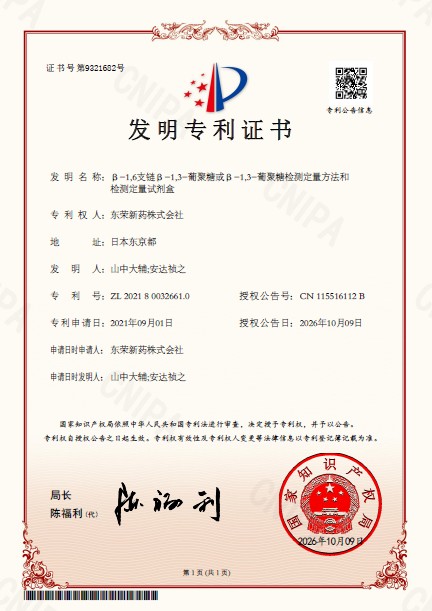
Overview of the Chinese Patent
- Chinese Patent No.: ZL 202180032661.0
- Grant Publication No.: CN 115516112 B
- Grant Publication Date (effective date of the patent right): October 9, 2026
- Title of the Invention: Method for detecting and quantifying β-1,6-branched β-1,3-glucan or β-1,3-glucan, and detection and quantification kit (Chinese title: β-1,6支链β-1,3-葡聚糖或β-1,3-葡聚糖检测定量方法和检测定量试剂盒)
- Patentee: Toei Shinyaku Co.,Ltd.
- Inventors: Daisuke Yamanaka, Yoshiyuki Adachi
- Filing Date: September 1, 2021 (International application PCT/JP2021/032154; priority date: September 7, 2020)
- Expiration Date: August 31, 2041
- Corresponding patents: Japan, Patent No. 7632898 (registered February 10, 2025) / United States, US 12,736,534 B2 (issued September 15, 2026)
About the Technology
β-glucans are the principal components of mushrooms such as Agaricus, and their properties differ depending on their linkage patterns and branching structures. This technology is a method and kit that uses a split reporter protein to detect and quantify β-1,6-branched β-1,3-glucan and β-1,3-glucan. When the target glucan is present in a sample, fusion proteins that bind to it reconstitute an active reporter protein, and the glucan is quantified by measuring the amount of that protein.
Applications are expected in the following areas:
- Detection and quantification of fungal-derived β-glucans, and potential future development toward diagnostic methods for fungal infections*
- Measurement of β-glucan content and quality evaluation of supplements, including those containing outdoor-cultivated Agaricus KA21
- Research on the mechanisms of action of β-glucans
*Application to the diagnosis of fungal infections is currently at the basic research stage. Before it can be used in clinical diagnosis, measurement performance and diagnostic accuracy must be verified using clinical specimens.
With rights now secured in Japan, the United States and China, a foundation is in place for using this technology in research and product quality evaluation in each country.
Patents on β-Glucan Measurement (Japan, United States and China)
Toei Shinyaku holds three patents on β-glucan measurement, all registered in Japan and the United States. The technology announced here has now also been registered in China, making it patented in three countries.
- [Japan, US] β-glucan-binding protein, β-glucan detection kit, artificial DNA and bacterium
Japan: Patent No. 6966756 (registered October 26, 2021) / US: US 11,542,307 B2 (issued January 3, 2023) - [Japan, US] β-1,6-glucanase variant and method for measuring β-1,6-glucan
Japan: Patent No. 7052967 (registered April 4, 2022) / US: US 11,479,803 B2 (issued October 25, 2022) - [Japan, US, China] Method for detecting and quantifying β-1,6-branched β-1,3-glucan or β-1,3-glucan, and detection and quantification kit (this announcement)
Japan: Patent No. 7632898 (registered February 10, 2025) / US: US 12,736,534 B2 (issued September 15, 2026) / China: ZL 202180032661.0 (published October 9, 2026)
The patentee of all three is Toei Shinyaku Co.,Ltd.
About β-Glucan and Agaricus
β-glucans are polysaccharides found in the cell walls of fungi such as mushrooms, molds and yeasts, and are broadly classified into β-1,3-glucans and β-1,6-glucans. β-1,3-glucan binds to Dectin-1 on immune cells and is involved in immune responses, and this recognition mechanism is applied in clinical practice to the diagnosis of invasive fungal infections.
Agaricus (scientific names: Agaricus blazei / brasiliensis / subrufescens) is known as a mushroom rich in β-glucans. Toei Shinyaku conducts research on Brazilian outdoor-cultivated Agaricus KA21 (Agaricus KA21), grown in the sunlight of Brazil, the native home of Agaricus, using the KA21 strain that the company holds exclusively. The technology announced here was born from that joint research.
Future Outlook
As a research-focused manufacturer specializing in Agaricus, Toei Shinyaku will continue to work on accurate β-glucan measurement technology and on elucidating the mechanisms of action of β-glucans, broadening the scientific foundation of Agaricus research. “KA21” is a registered trademark in Japan, China, the EU and Taiwan. Together with this Chinese patent, the company will continue to communicate the research results and quality of outdoor-cultivated Agaricus KA21 overseas.
About Toei Shinyaku Co.,Ltd.
Founded in 1973, Toei Shinyaku is a research-focused manufacturer specializing in Agaricus, and also manufactures and supplies Agaricus raw materials. Since 1996 the company has been engaged in the research, development and commercialization of the KA21 strain. Through joint research with institutions including Tokyo University of Pharmacy and Life Sciences, Azabu University, Keio University, the National Center for Geriatrics and Gerontology, Juntendo University, the University of Tokyo and Shigakkan University, it has published 34 international papers to date. For β-glucan measurement technology, it holds patents in Japan, the United States and China.
- Company name: Toei Shinyaku Co.,Ltd.
- Head office: 1-11-23 Shimorenjaku, Mitaka, Tokyo 181-0013, Japan
- Representative: Akitomo Motoi, Representative Director
- Capital: JPY 10 million
- Business: Research, development, manufacturing and sales of the Agaricus raw material “Outdoor-Cultivated Agaricus KA21”; OEM of supplements
- URL: https://toeishinyaku.com/ / https://agaricus.co.jp/